
From Population Collapse towards Recovery: The new publication documenting the Darwin's frog emergency in Parque Tantauco
In the new article "From Population Collapse towards Recovery: Protecting Darwin's Frogs in Parque Tantauco", published as a Special Report in British Herpetological Society Reports, we estimate that approximately 76% of the known populations in the Inío sector of Chiloé were wiped out following the introduction of the chytrid fungus, and that between 850 and 1,344 Darwin's frogs died from the disease in this area alone between 2023 and 2024.
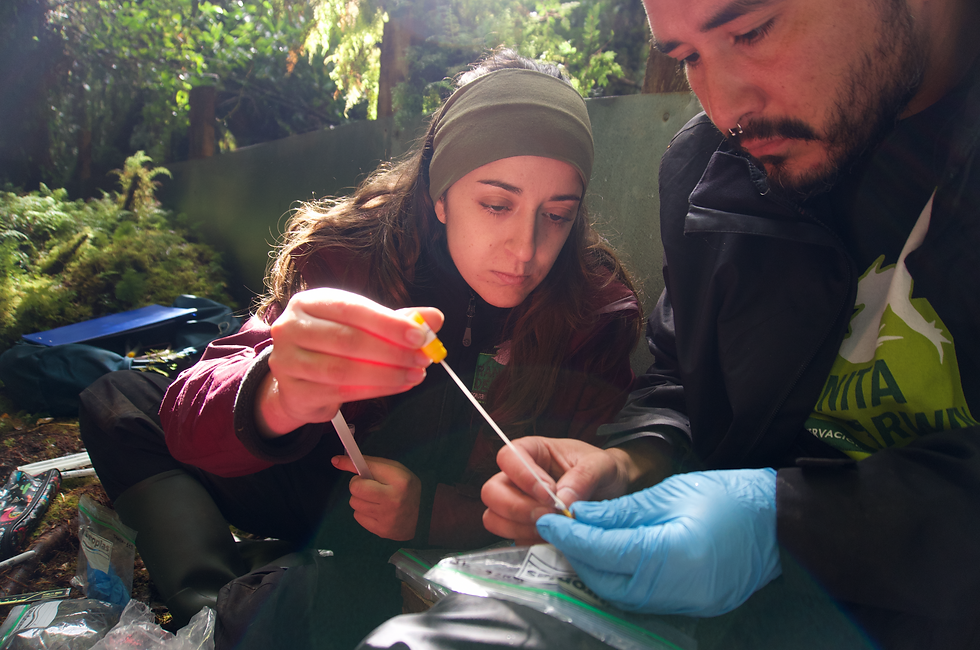
It is, to date, the most complete account of the Alianza Tantauco project, bringing together the story of the outbreak, new data and analyses, the emergency conservation response, and the communication and public engagement strategy that accompanied it.
An unprecedented collapse
Parque Tantauco, a 100,000-hectare privately protected area on Chiloé Island in southern Chile, was the last great stronghold of the Darwin's frog (Rhinoderma darwinii): it harboured the largest known populations and remained free of the chytrid fungus Batrachochytrium dendrobatidis (Bd), the causative agent of chytridiomycosis, until 2022.
From 2023 onwards, everything changed. We had previously reported the dramatic declines of 91% and 98% in two intensively monitored populations (TAN1 and TAN2) following the arrival of Bd. The new report widens that picture: the analyses show that the impact was far greater. The occupancy model estimated a local extirpation probability of 0.761, which translates into approximately 10 of the 14 known local populations in the Inío sector disappearing following the invasion of the fungus.
To put the loss into perspective: in 2014, five monitored populations totalled 421 frogs, with an average of 84 per site. In 2024, after the outbreak, only 11 individuals were detected across the occupied sites; in 2025, a mere 21.
The emergency response: 13,000 kilometres to save a species
Faced with the imminent disappearance of the populations, one of the first actions was to establish a national and international network of captive breeding centres. In October 2024, 53 Bd-free frogs (including 12 males carrying tadpoles in their vocal sacs, the species' iconic paternal care) travelled approximately 13,000 kilometres by sea, land and air to ZSL London Zoo (Zoological Society of London) in a 52-hour journey inside a custom-designed, insulated transport crate. At least 51 people from nine institutions took part in this complex logistical operation.
The results in captivity are encouraging: by January 2025, eleven males had successfully reared 33 metamorphs, and the first egg-laying at ZSL London Zoo was recorded in December 2024, a key indicator for the establishment of a viable colony. In parallel, in January 2025 a second assurance colony of 32 Bd-free frogs was established at the Universidad de Concepción's breeding and research station, within the species' native range.
As Dr Andrés Valenzuela-Sánchez, project leader, President of ONG Ranita de Darwin and researcher at the Zoological Society of London, noted: "Darwin's frogs are highly susceptible to chytridiomycosis; when a frog becomes infected, it can die within a matter of weeks, and the disease can bring about the disappearance of entire populations."


Science in the field: exclusion experiments against the fungus
The article also details the on-the-ground actions. Empirical evidence and modelling indicate that Bd transmission in the Darwin's frog is highly localised and depends strongly on host density and contact with amphibians sharing the habitat. An individual-based model predicts that reducing this contact can substantially lessen the impact of the disease. Building on this, in 2025 ONG Ranita de Darwin and Parque Tantauco launched an exclusion experiment in Inío, using solid fences combined with the removal of co-occurring amphibians from outside the fenced areas, alongside biosecurity measures such as footwear disinfection at the park's access points.

Strategic communication
ONG Ranita de Darwin, the Zoological Society of London and other collaborators developed a communications plan designed and led from Chile: ONG Ranita de Darwin informed the local community of Inío first, secured a formal letter of endorsement from the Minister for the Environment, and only then made the public announcement through a national webinar.
The result exceeded expectations: more than 410 news items across media outlets in Chile, the United Kingdom, France, Italy, Portugal, Argentina, Spain and Australia, with a potential reach of at least 167 million people. The story even featured in the BBC's weekly quiz. The mission was documented by BAFTA-winning filmmaker Paul Glynn in the documentary "A Leap of Hope: A Huge Mission to Rescue a Tiny Frog", premiered in February 2025.

Collaborators and institutions
This achievement is a collective one. The article was written by Andrés Valenzuela-Sánchez, Benjamin Tapley, Bastián Santana, Alan Bannister, Pablo Aguilar, Soledad Delgado, José Manuel Serrano, David Uribe-Rivera, Claudia Faure, Jaime Beltrand, Diego Peñaloza, Michael Meyerhoff, Claudio Azat, Daniel Kane, Chris Sergeant and Andrew Cunningham, and edited by Simon Townson.
The Alianza Tantauco comprises ONG Ranita de Darwin, the Zoological Society of London, Fundación Parque Tantauco, Zoo Leipzig, Universidad Andrés Bello, Universidad de Concepción, the Zoológico Nacional del Parquemet, and the IUCN SSC Amphibian Specialist Group (Amphibian Specialist Group of the Species Survival Commission of the International Union for Conservation of Nature).
All are members of the Binational Conservation Strategy for Darwin's Frogs, which brings together 24 organisations from Chile, Argentina, Germany and the United Kingdom.
Our warmest thanks to all the co-authors, organisations, field teams, communities and individuals who have supported this collaborative effort to move from population collapse towards recovery.
Complete Report here: https://www.thebhs.org/publications/british-herpetological-society-reports/4666-bhs-reports-no-8-special-report-darwin-s-frog
For more information on Tantauco Alliance Click Here
Thank you for reading "From Population Collapse towards Recovery: The new publication documenting the Darwin's frog emergency in Parque Tantauco"
Puedes ser parte de nuestra ONG mediante el programa de donaciones Adopta una Ranita de Darwin, Conviértete en Guardian de una Ranita de Darwin en https://www.ranitadedarwin.org/adoptayunete


Comments